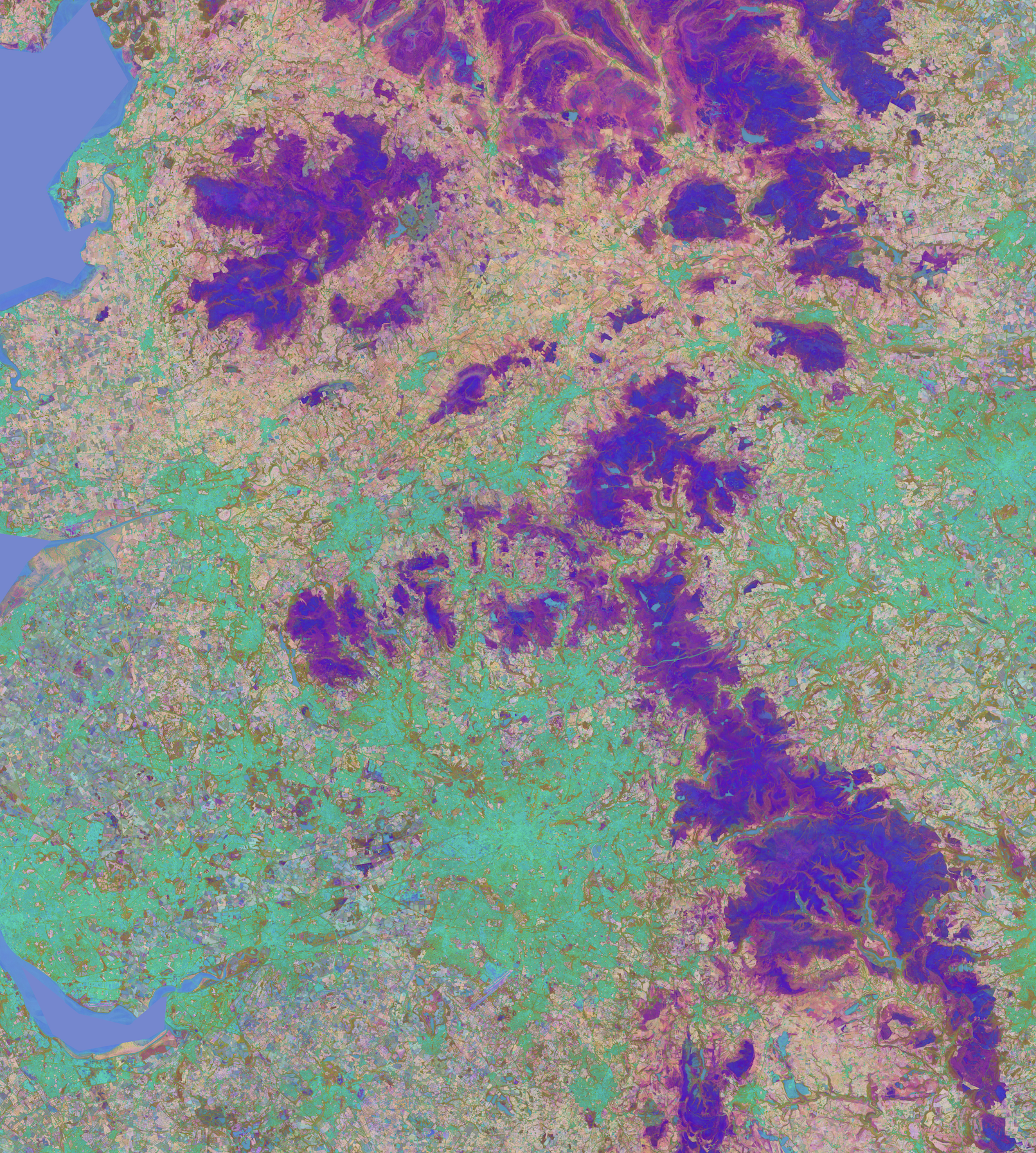
The Tessera pipeline is written in Python. What would it take to have an OCaml version?
Looking at the Python code, these are the key libraries which are used:
| Python Library | Used for |
|---|---|
| numpy | N-dim arrays, math, .npy I/O |
| torch | Model inference |
| rasterio | Read GeoTIFF (ROI mask), CRS/bounds, transform_bounds |
| pystac-client | STAC API search (Planetary Computer catalog) |
| planetary-computer | Sign STAC URLs (Azure SAS tokens) |
| stackstac | Load COGs into arrays, reproject, mosaic |
numpy
Last year, when I first looked at the Tessera titles, I wrote mtelvers/npy-pca as a basic visualisation tool that included an npy reader. Now, I have spun that off into its own library mtelvers/ocaml-npy. I subsequently noticed that there already was LaurentMazare/npy-ocaml which may have saved me some time!
pystac-client and planetary-computer
For these, a new library was needed as I couldn’t see an OCaml equivalent. However, OCaml already has Eio, cohttp-eio and yojson, so it was relatively easy to produce mtelvers/stac-client, which implemented the STAC (SpatioTemporal Asset Catalogue) API, with built-in support for Microsoft Planetary Computer SAS token signing. This was easy to validate against the results from Python.
rasterio
geocaml/ocaml-tiff already exists, but it does not handle tiled tiff files, which are used in the land masks. Rather than reinventing the entire library, I added tiled tiff support.
stackstac
geocaml/ocaml-gdal already existed, but it lacked some required features and was a little outdated. More bindings were added for GDAL’s C API using OCaml’s ctypes-foreign adding:
GDALOpenExwith/vsicurl/for reading remote COGsGDALWarpfor reprojection and resamplingGDALRasterIOfor reading band dataOSRNewSpatialReference/OCTTransformBoundsfor coordinate transformations
torch
LaurentMazare/ocaml-torch already existed with the latest version published on opam janestreet/torch. This uses the Jane Street standard library but it seemed pointless to reimplement this using the OCaml Standard Library, so instead, I went with implementing the OCaml bindings for the ONNX runtime mtelvers/ocaml-onnxruntime as I only need the inference stage. The PyTorch model can be easily exported to ONNX format.
ONNX Runtime’s C API uses a function-table pattern (a struct with 500+ function pointers) which doesn’t easily map to ctypes. This needed a thin C shim (libert_shim.so) that exposed the needed functions as regular C symbols, which could be bound from OCaml.
CPU Testing
The initial OCaml pipeline was tested on my local machine without a GPU. It stored satellite data as nested OCaml arrays (float array array array array for 4D data), which performed poorly. This was replaced with flat Bigarray.Array1.t using a stride-based index arithmetic, matching NumPy’s contiguous memory layout, which performed much better. However, the real test was on a GPU.
Benchmark results
All benchmarks on the same machine (AMD EPYC 9965 2 x 192-Core, NVIDIA L4 24GB), same dataset (269,908 pixels), same parameters (batch_size=1024, num_threads=20, repeat_times=1):
| Rank | Configuration | Inference Time | vs Python CPU |
|---|---|---|---|
| 1 | OCaml + ONNX Runtime + CUDA | 2 min 10s | 9.5x faster |
| 2 | Python + PyTorch + CUDA | 2 min 41s | 7.7x faster |
| 3 | Python + PyTorch (CPU) | 20 min 32s | 1x (baseline) |
| 4 | OCaml + ONNX Runtime (CPU) | 24 min 56s | 0.82x |
The OCaml + GPU configuration is the fastest overall. I put this difference down less data marshalling in OCaml before passing it to the ONNX runtime. I’ve also read that the ONNX Runtime might edge out ahead of PyTorch as it was purpose-built as an inference-only engine.
Checks
The OCaml pipeline produces results that are effectively identical to Python’s, differing only due to floating-point rounding.
- OCaml CPU vs Python CPU: max embedding difference of 1 in only 1,028 out of 155 million int8 elements (rounding at the quantisation boundary). Scale factors match exactly.
- GPU vs CPU (either language): max embedding difference of 1 in ~0.3% of elements, with negligible scale differences — expected floating-point rounding differences from GPU arithmetic.